
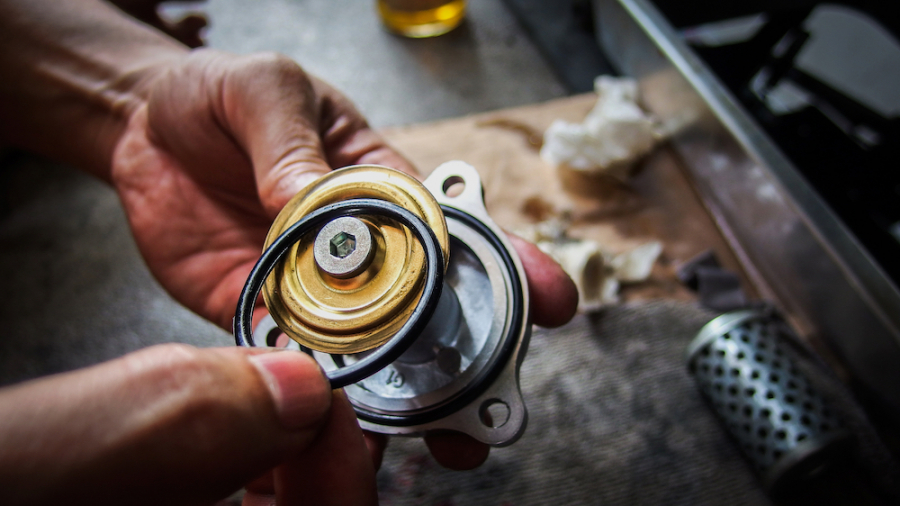
Typical applications
The correct design of a seal by means of O-rings requires a rigid mechanical installation. This, in turn, gradually causes predictable deformation of an O-ring. It is important to calculate the mechanical stress on the contact surfaces of an O-ring. The contact stress of the product increases as the pressure of the liquid inside increases. Leakage is not possible as long as this pressure does not exceed the contact stress. An O-ring can easily withstand such a load if it retains its integrity, that is, it is not mechanically damaged. A common violation of the part’s normal operation is its extrusion through mating elements.
O-rings
An O-ring (that is, having a circular cross-section) is required for point contact between a seal and surfaces to be sealed. As a result, it becomes possible to have a high local load and the ability to withstand high pressure without increasing a yield strength of the rubber from which the product is made.
A rubber O-ring, due to flexibility of the material from which it is made, has some disadvantages during the installation process. In particular, it is necessary to ensure that the surfaces of the elements being connected are clean, especially at low temperatures. After all, when a rubber seal reaches its glass transition temperature, it becomes more crystalline. In this case, especially when an O-ring is used dynamically, it is important to finish the surface.
Damage to the part
The material of a seal can be exposed to high or low temperatures, certain chemicals, vibration, and friction. In this regard, elastomers are selected according to their field of application. So, it is possible to buy an O-ring that can withstand temperatures up to 250 °C or down to -200 °C. In general, at low temperatures, most materials acquire rigidity, lose the property of a hermetic seal; at high temperatures, they often decompose or burn out.
The product can break down as a result of chemical action — cracks appear and rubber swells. For example, unprotected NBR seals often crack when exposed to ozone, even at low ozone concentrations. On contact with low viscosity fluids, the size of an O-ring increases due to the swelling of an elastomer, and there is a risk of rupture.
A seal does not cope with its function if the cross-sections of O-rings do not match the dimensions of specific grooves. This provokes extrusion of the material.
Rubber is sensitive to ionizing radiation. Usually, O-rings are protected from weakly penetrating radiation (ultraviolet and soft X-ray); but more penetrating radiation (for example, neutron) can quickly degrade the properties of the product. Therefore, soft metal seals are used in such environments.